Neck, shoulder, and back pain have become commonplace in modern life, especially among people who spend long hours hunched over computers or smartphones until the body loses its natural balance. Many turn to Pilates as a solution.
But the question is: is Pilates really good for your spine? And when should you stop exercising and see a doctor?
What Is Pilates? Why Does It Focus on Spinal Health?
Pilates is not just another form of exercise. It emphasizes the quality of movement through three core principles:
1.Posture — Aligning the body in its natural, neutral position to reduce unnecessary pressure on the spine.
2.Core strength — Strengthening the deep muscles of the abdomen, back, and pelvis — the essential structures that support the spine.
3.Controlled movements — It focuses on slow, mindful, and precise movements that minimize the risk of injury from poor body mechanics.
Unlike workouts that emphasize intensity, Pilates emphasizes quality of movement, making it ideal for anyone who wants to protect the spine and joints over the long term.
Why Is Pilates So Beneficial for the Spine?
Pilates is excellent for spinal health because it helps build muscle that reduces the risk of spinal problems. Its benefits work on several levels:
1.Strengthens the muscles surrounding the spine — Strong core muscles act like “armor” that supports and protects the spine. When these muscles are strong, the spine doesn't have to bear the load directly, reducing impact forces and lowering the risk of injury.
2.Reduces the risk of spinal problems — The guiding principle is simple: Strong muscles equal a safer spine. Balanced muscles around the spine reduce the incidence of back pain, disc degeneration, and related conditions.
3.Restores body balance — Pilates corrects postural imbalances caused by prolonged sitting, a major contributor to neck, shoulder, and back pain in today's working population.
Why Do Some People Experience Pain More Than Others When They Exercise?
Many people have hidden spinal issues they're not aware of, such as:
- Herniated discs compressing nerves
- Muscle imbalances
- Degenerative spinal conditions
- Nerve problems originating in the neck or lower back
When these individuals start intense or perform an exercise improperly, the underlying conditions begin to surface. Symptoms include:
- Radiating pain
- Numbness
- Weakness
- Dropping objects easily
A proper health assessment before starting an exercise program is so important.
When You Should Stop and See a Doctor Immediately
Although Pilates is generally a safe form of exercise, there are warning signs that may indicate a hidden spinal problem. If you experience any of the following, stop exercising and consult a doctor right away.
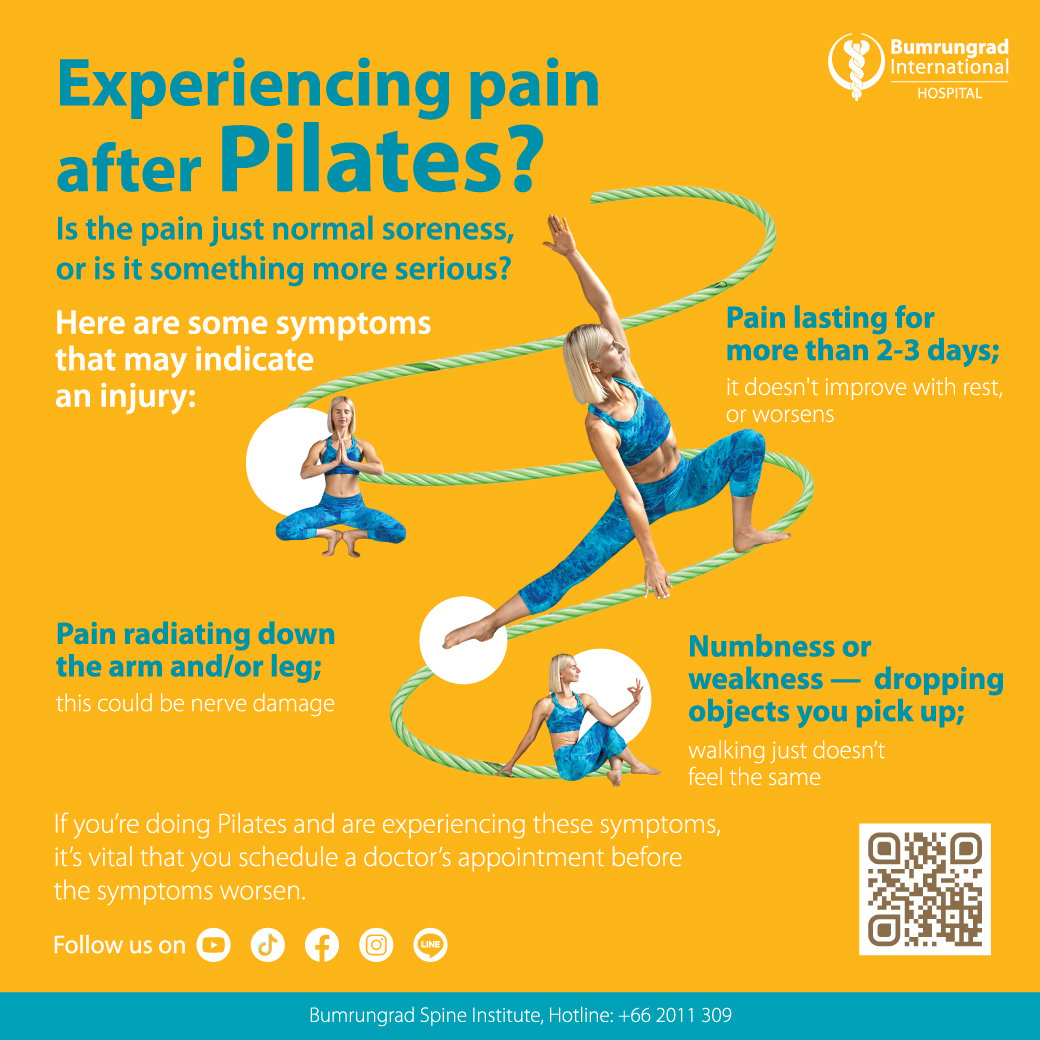
- Unusual pain lasting more than 2–3 days — Pain that doesn't subside within 2–3 days, or feels different from anything you've experienced before, is the first sign that you should see a doctor.
- Pain radiating down the arm or leg — Neck pain radiating down the arm may indicate a cervical disc problem; lower back pain radiating down the leg may be a lumbar disc compressing a nerve.
- Severe pain that is non-responsive to painkillers — If your pain is severe and standard pain medication doesn't help, this is a sign that the problem isn't just ordinary muscle tightness.
- Numbness or loss of sensation — Numbness in the arms, legs, or fingertips may indicate that a nerve is being compressed.
- Weakness or frequently dropping objects — Weakness in the arms or legs for example, frequently dropping items you're holding, is a neurological warning sign that requires thorough evaluation.
Some people have spinal problems without realizing it. When they begin intense or improperly performed exercise, hidden symptoms such as numbness or weakness may emerge. A health assessment before starting any exercise program is recommended.
Can Pilates Help Relieve Aches and Pains?
For office workers, neck, shoulder, and back pain typically result from prolonged sitting, poor posture, and a weak core. Pilates can help by:
- Correcting posture
- Reducing pressure on the neck and back
- Building core strength
- Releasing accumulated muscle tension
If you are also experiencing radiating pain, numbness, or weakness, see a doctor before starting any exercise routine.
Pilates Supports Spinal Health, It's Not a Treatment
It's important to understand that Pilates is not a treatment for spinal issues. It is a tool for care, prevention, and rehabilitation if it is performed properly.
If you already have a spinal condition such as a herniated disc, spinal degeneration, or a history of spinal surgery, always consult a doctor first.
How to Get Started If You've Never Tried Pilates
- Start with the basics — You don't need to start with Reformer Pilates. Mat Pilates is enough to build a solid foundation.
- Choose a qualified instructor — especially if you already have back pain. And train with an instructor who understands biomechanics and physical limitations.
- Listen to your body — If you feel pain rather than muscle fatigue, stop immediately.
Who Should Try Pilates?
Pilates is suitable for a wide range of people, including:
- Office workers with chronic neck and back pain
- Older adults looking to build strength without impact on the joints
- Athletes who want to improve movement efficiency and prevent injury
- People in post-injury rehabilitation (under professional supervision)
- Anyone seeking to improve their body balance and posture
Frequently Asked Questions (FAQ)
Q: I already have back pain. Can I still do Pilates?
A: Yes, if your pain is from general muscle tightness. But if you have radiating pain, numbness, or weakness, see a doctor first.
Q: What's the difference between Pilates and physical therapy?
A: Physical therapy focuses on treating and rehabilitating injuries. Pilates focuses on building strength and preventing long-term problems.
Q: How is Pilates different from yoga?
A: Both emphasize flexibility and body control. However, Pilates places more emphasis on core strength and precise, controlled movement, while yoga emphasizes stretching, breathing, and mental practice.
Q: How often must I do Pilates to see results?
A: Generally, practicing Pilates 2–3 times per week consistently for 8–12 weeks will produce noticeable improvements in strength and posture.
Q: Can people of all ages do Pilates?
A: Yes. Pilates is a safe form of exercise that can be modified to suit individual needs, from teenagers to seniors.
Q: Do I need special equipment?
A: You can begin with Mat Pilates, which requires only a mat. Reformer Pilates uses specialized equipment that provides varied resistance and is suited to more advanced training.
Q: When should I stop doing Pilates and see a doctor?
A: Stop immediately if you experience unusual pain lasting more than 2–3 days, pain radiating down the arms or legs, severe pain unrelieved by medication, or numbness or weakness in the limbs.
Conclusion
Pilates is an excellent form of exercise for maintaining spinal health, strengthening the core, improving posture, and reducing the long-term risks of spinal problems. However, warning signs such as pain radiating into the limbs, numbness, or weakness should never be ignored. Consulting a spine specialist early is key to preventing potential problems.
By
Dr. Verapan Kuansongtham, Spine Surgeon and Neurosurgeon at Bumrungrad International Hospital and Director of the Bumrungrad Spine Institute

For more information please contact:
Last modify: May 22, 2026