Robotic-assisted minimally invasive direct coronary artery bypass, or robotic-assisted MIDCAB, is a form of minimally invasive heart bypass surgery for selected patients. It is most commonly used to bypass a significantly narrowed or blocked left anterior descending coronary artery (LAD) through small chest incisions without dividing the breastbone.
Bumrungrad International Hospital in Bangkok, Thailand, performed the first robotic-assisted MIDCAB procedure at a private hospital in Thailand. Led by Asst. Prof. Boonlawat Homvises, M.D., the procedure expands the minimally invasive cardiac treatment options available to selected patients with coronary artery disease.
Who May Be Eligible for Robotic-Assisted MIDCAB?
Robotic-assisted MIDCAB is most often considered for patients with a significant LAD blockage. The LAD supplies blood to a large area of the heart muscle, making appropriate treatment important for preserving heart function and reducing cardiovascular risk.
Some patients with blockages in more than one coronary artery may be candidates for
hybrid coronary revascularization. This approach combines a robotic-assisted LIMA-to-LAD bypass with angioplasty and stenting for other narrowed coronary arteries.
Not every patient with coronary artery disease is suitable for robot-assisted MIDCAB or another form of minimally invasive CABG. Eligibility may depend on:
- The location, severity, and number of coronary blockages
- Coronary anatomy
- Heart and lung function
- Previous chest surgery or radiation treatment
- Other medical conditions
- Overall surgical and anesthetic risk
A multidisciplinary heart team evaluates each patient to determine whether robotic-assisted MIDCAB, conventional CABG, angioplasty and stenting, hybrid treatment, or another approach is
most appropriate.
How Does Robotic-Assisted MIDCAB Work?
The robotic system does not perform the operation independently. Every movement of the camera and surgical instruments is controlled by the cardiac surgeon from a specialized console.
During the procedure:
- The surgeon creates several small access points, known as ports, in the chest.
- A camera and robot-assisted instruments are inserted through the ports.
- The left internal mammary artery (LIMA), also called the left internal thoracic artery, is carefully prepared.
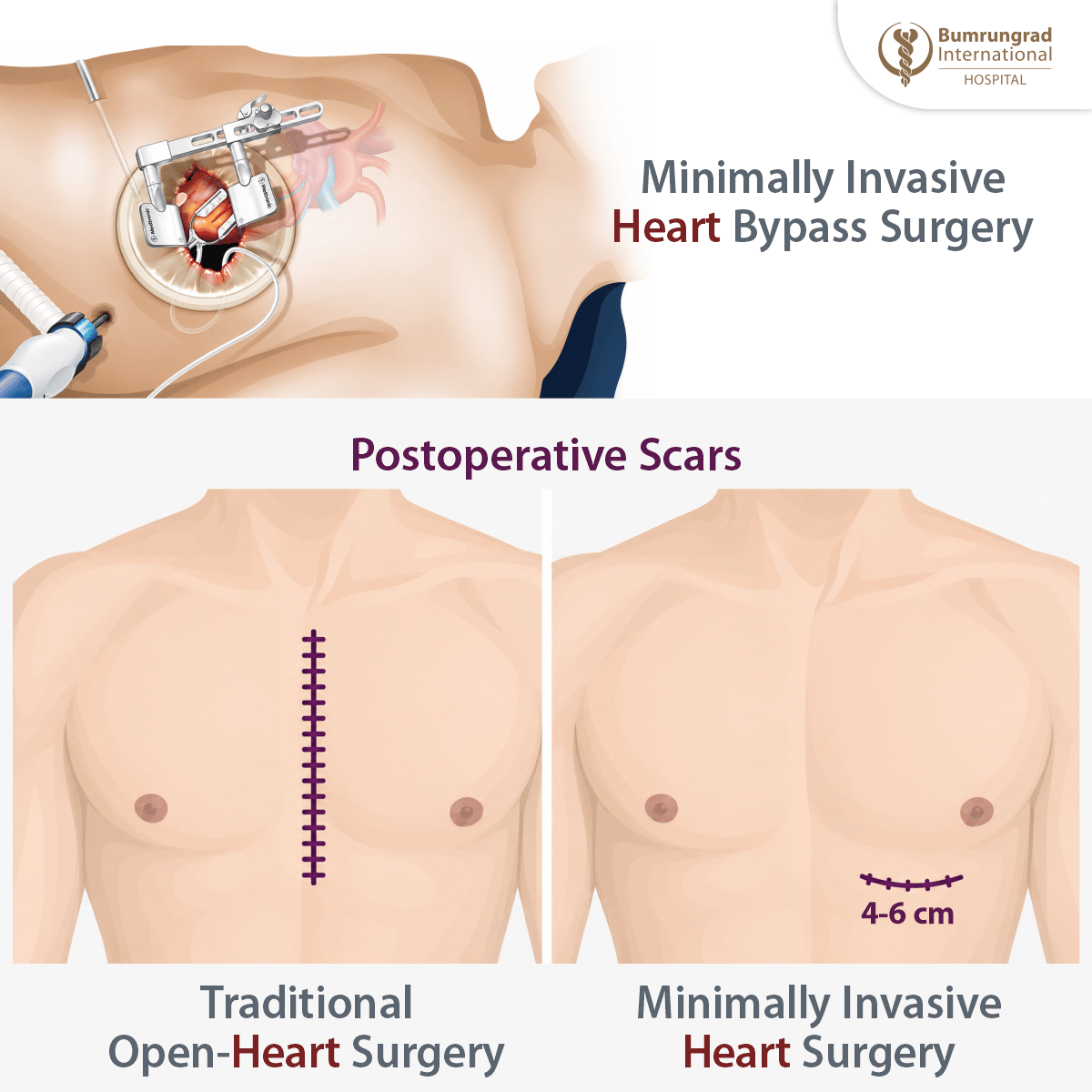
- A limited incision is made between the ribs.
- The LIMA is connected to the LAD beyond the blockage, creating a new pathway for blood flow.
The LIMA-to-LAD bypass is commonly completed while the heart continues beating and without using a heart-lung bypass machine. However, the exact surgical plan may vary according to the patient’s condition and procedure complexity.
The robotic system provides a magnified, three-dimensional view of the surgical area. Its instruments can bend and rotate within the confined space of the chest, supporting precise surgical movements.
Potential Benefits and Risks
Because the breastbone generally remains intact, potential benefits for appropriately selected patients may include:
- Smaller incisions and less visible scarring
- Potentially less surgical trauma and blood loss than conventional sternotomy-based CABG
- Potentially less postoperative discomfort during early recovery
- Lower risk of certain complications associated with dividing the breastbone
- A potentially shorter hospital stay
- Faster early recovery and return to daily activities
These benefits are not guaranteed and vary according to the patient’s health, coronary anatomy, and procedure complexity.
Robotic-assisted MIDCAB remains major heart surgery. Possible risks include bleeding, infection, irregular heart rhythm, heart attack, stroke, graft narrowing or blockage, reactions to anesthesia, injury to nearby structures, or conversion to conventional open-heart surgery.
The cardiac care team discusses the expected benefits, risks, and alternative treatments before surgery.
Robotic-Assisted MIDCAB vs Conventional CABG
|
Feature
|
Robotic-assisted MIDCAB
|
Conventional CABG
|
|
Surgical access
|
Small ports and a limited incision between the ribs
|
Central chest incision
|
|
Breastbone
|
Usually remains intact
|
Usually divided
|
|
Typical use
|
Selected blockages, commonly involving the LAD
|
May treat several coronary arteries
|
|
Common graft
|
LIMA-to-LAD bypass
|
Arterial or vein grafts
|
|
Heart-lung machine
|
Usually not required
|
Commonly used, although off-pump CABG is possible
|
|
Early recovery
|
May be faster for suitable patients
|
Usually longer while the breastbone heals
|
Conventional CABG may be more appropriate for patients who require several bypass grafts, have complex coronary anatomy, or need more extensive surgical treatment. The choice should be based on a comprehensive heart team evaluation rather than incision size alone.
Recovery After Robotic-Assisted MIDCAB
Recovery varies according to the patient’s overall health, heart function, procedure complexity, and progress after surgery. Because the breastbone is generally not divided, suitable patients may experience a faster early recovery than after conventional sternotomy-based CABG.
After surgery, the care team monitors heart rhythm, breathing, pain control, wound healing, and the patient’s ability to walk and perform daily activities. Before leaving the hospital, patients receive individualized instructions regarding medications, incision care, physical activity, driving, returning to work, and follow-up appointments.
Cardiac rehabilitation may also be recommended to support safe physical recovery, medication management, heart-healthy lifestyle changes, and long-term cardiovascular health.
Frequently Asked Questions
Does the robot perform the surgery?
No. The robotic system does not operate independently. Every movement is controlled directly by the cardiac surgeon.
Does robotic-assisted MIDCAB require dividing the breastbone?
Generally, no. The procedure uses small ports and a limited incision between the ribs without dividing the breastbone.
Does the heart stop during MIDCAB?
MIDCAB is commonly performed while the heart continues beating. The exact approach depends on the patient’s health, coronary anatomy, and treatment plan.
Can MIDCAB treat multiple blocked arteries?
MIDCAB is most commonly used for a LIMA-to-LAD bypass. Selected patients with additional blockages may receive hybrid treatment combining MIDCAB with angioplasty and stenting.
How long does recovery take?
Recovery differs for each patient. Suitable patients may recover more quickly than after conventional CABG because the breastbone is not divided. The expected timeline depends on the patient’s health, procedure complexity, and postoperative progress.
Who is suitable for robotic-assisted MIDCAB?
Suitability depends on the location and complexity of the blockage, coronary anatomy, previous treatments, heart and lung function, and other health factors. A multidisciplinary heart team must evaluate each patient.
Multidisciplinary Heart Care at Bumrungrad
At the
Bumrungrad Heart Institute and
Bumrungrad Robotic Surgery Center, cardiac surgeons, interventional cardiologists, cardiac imaging specialists, anesthesiologists, nurses, rehabilitation professionals, and other healthcare specialists collaborate to recommend an individualized treatment plan.
In
Newsweek and Statista’s Best Specialized Hospitals Asia Pacific 2026 rankings, Bumrungrad was ranked 15th in Cardiology and 29th in Cardiac Surgery, placing No. 1 in Thailand in both specialties.
Patients with coronary artery disease should consult a cardiologist and cardiac surgeon to determine which treatment approach is appropriate for their individual condition.
Medically reviewed by:
Asst. Prof. Boonlawat Homvises, M.D.
Cardiac and Thoracic Surgery
For more information please contact:
Last modify: July 17, 2026